In the competitive landscape of electric motor manufacturing, efficiency is the primary differentiator. Motor designers worldwide are challenged to achieve higher power density, lower energy losses, and improved thermal performance—all while meeting stringent cost targets.
One technology that has emerged as a game-changer is self-bonding lamination. Originally developed for specialized applications, this manufacturing method has become increasingly mainstream as EV, eVTOL, and robotics manufacturers demand superior performance.
This technical guide provides an in-depth analysis of self-bonding lamination technology, its benefits over traditional methods, and practical considerations for engineers and procurement professionals.
1. Understanding Motor Core Losses
Before examining self-bonding technology, its essential to understand the fundamental loss mechanisms in motor cores. Total core losses consist of three components:
1.1 Hysteresis Losses
Hysteresis loss occurs due to the energy required to repeatedly magnetize and demagnetize the core material. This is inherent to the magnetic domain structure of the steel and is proportional to the frequency of magnetization cycles.
Key insight: Lower-grade electrical steels with smaller grain sizes exhibit lower hysteresis losses. The silicon content in electrical steel (typically 2-3.5%) increases resistivity, reducing this loss component.
1.2 Eddy Current Losses
Eddy currents circulate within the conductive steel laminations when exposed to changing magnetic fields. These currents generate heat proportional to the square of lamination thickness.
According to fundamental electromagnetic theory:
Pe ∝ t² /ρ
Where:
Pe = eddy current loss
t = lamination thickness
ρ = electrical resistivity
This relationship explains why thinner laminations dramatically reduce losses. A reduction from 0.35mm to 0.1mm thickness reduces eddy current losses by approximately 12x.
1.3 Anomalous Losses
Anomalous losses arise from microscopic magnetic domain wall movements during magnetization. These are more difficult to quantify but are influenced by material grain structure and surface quality.
2. Traditional Lamination Attachment Methods
2.1 Resistance Welding
Welding is among the most common attachment methods, particularly for larger cores. The process involves passing high current through the lamination stack at specific points, creating localized molten zones that fuse upon cooling.
Advantages:
- High mechanical strength
- Fast processing for large cores
- Low tooling cost
Disadvantages:
- Heat-affected zone degrades magnetic properties
- Insulation damage at weld points increases eddy currents
- Thermal distortion affects dimensional accuracy
- Difficulty with thin laminations (<0.2mm)
Research indicates that welding can increase core losses by 5-10% in the heat-affected zones.
2.2 Riveting
Riveting uses mechanical fasteners to clamp lamination stacks together. This method remains popular for applications requiring easy disassembly.
Advantages:
- No heat input—preserves material properties
- Simple process control
- Easy repair and maintenance
Disadvantages:
- Stress concentrations at rivet holes
- Limited to thicker laminations
- Weight penalty from rivet material
- Potential for inter-laminar corrosion
2.3 Laser Welding
Laser welding offers precision control with minimal heat input compared to resistance welding.
Advantages:
- Narrow heat-affected zone
- High processing speed
- Good for automated production
Disadvantages:
- High equipment investment
- Requires precise joint fit-up
- Not suitable for very thin laminations
3. Self-Bonding Lamination Technology
3.1 Process Overview
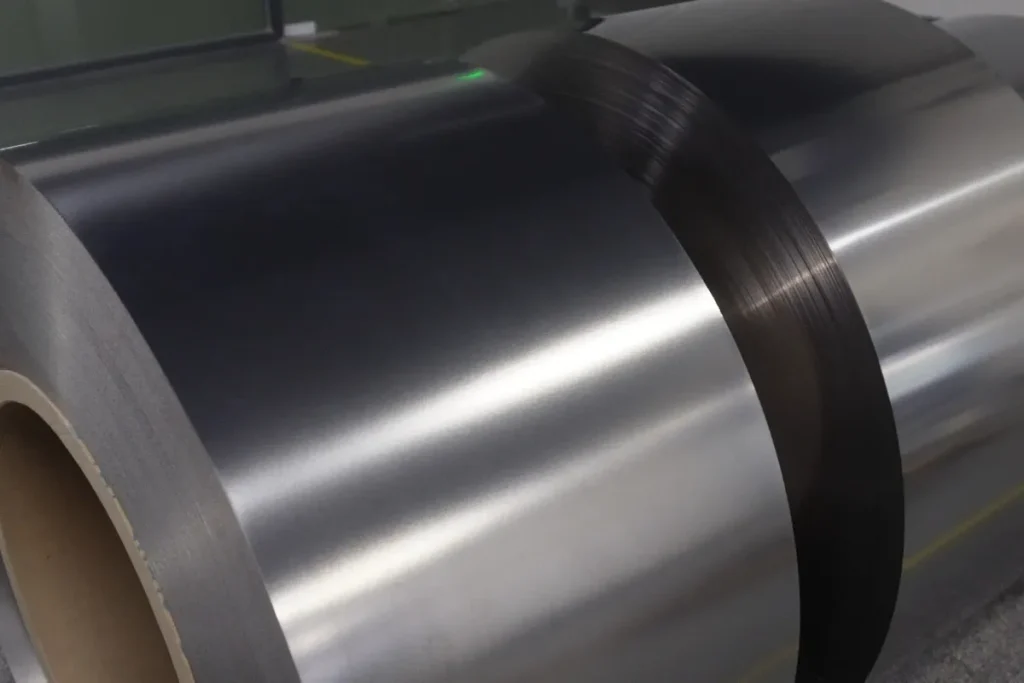
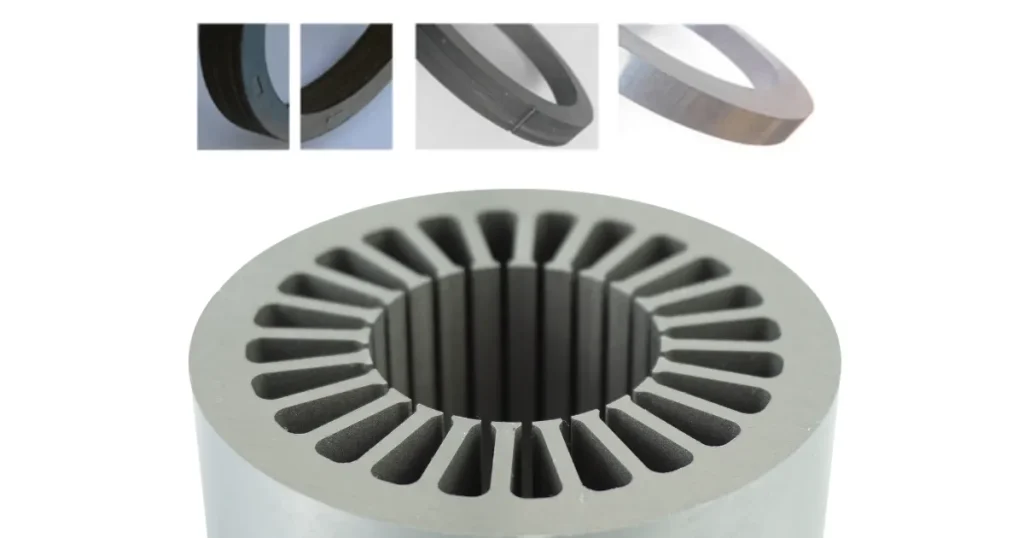
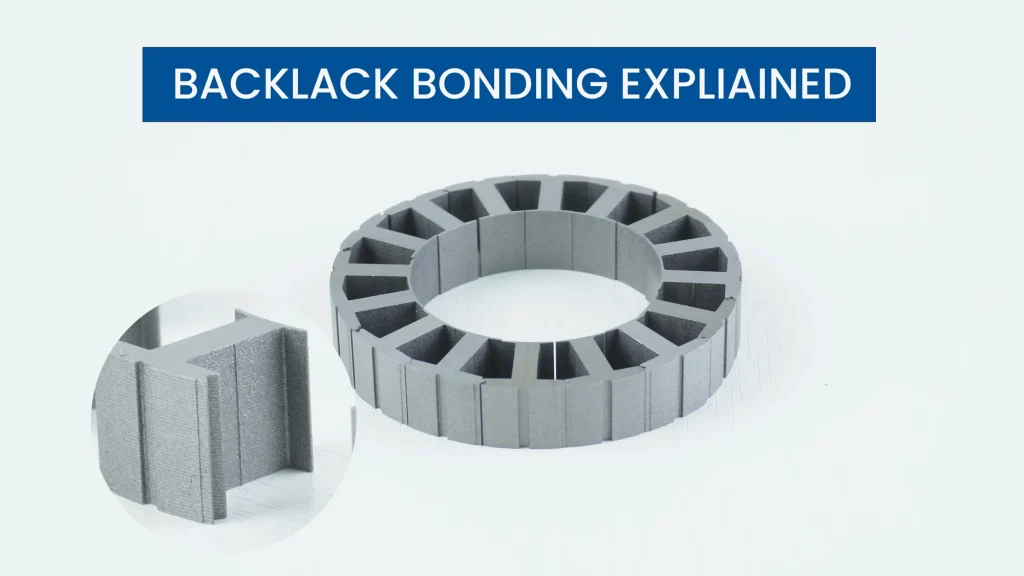
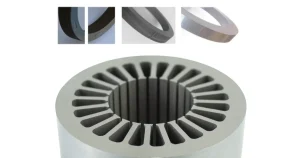
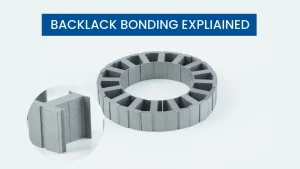
Self-bonding utilizes pre-coated electrical steel laminations with a thermosetting adhesive film. During stack assembly, heat and pressure activate the adhesive, creating a molecular bond between adjacent layers.
Process Flow:
- Lamination Stamping: Precision-stamped electrical steel sheets with adhesive film pre-applied
- Stack Assembly: Laminations stacked in precision fixture
- Curing: Heat (150-200°C) and pressure applied for 2-4 hours
- Quality Verification: Dimensional and magnetic testing
3.2 Adhesive Systems
Modern self-bonding adhesives are typically epoxy-based or polyester-based films:
| Adhesive Type | Cure Temp | Bond Strength | Application |
|---|---|---|---|
| Epoxy Film | 180-200°C | High | Premium applications |
| Polyester Film | 150-170°C | Medium | Cost-sensitive |
| Hybrid | 160-180°C | Medium-High | General purpose |
3.3 Compatible Materials
Self-bonding is compatible with various soft magnetic materials:
- Non-oriented electrical steel (NO20-NO35)
- Grain-oriented electrical steel (specific grades)
- Amorphous steel
- Nanocrystalline alloys
4. Performance Benefits: Quantitative Analysis
4.1 Core Loss Reduction
Independent testing confirms significant core loss improvements with self-bonding:
| Lamination Thickness | Method | Core Loss (W/kg) @ 1T, 50Hz | Improvement |
|---|---|---|---|
| 0.35mm | Welding | 2.8 | Baseline |
| 0.35mm | Self-Bonding | 2.4 | 14% |
| 0.20mm | Welding | 1.9 | – |
| 0.20mm | Self-Bonding | 1.6 | 16% |
| 0.10mm | Self-Bonding | 0.9 | 53% vs 0.35mm welding |
Note: Values are representative for standard non-oriented electrical steel. Actual results vary by material grade and core geometry.
4.2 Stacking Coefficient
Stacking coefficient (fill factor) measures how efficiently the core volume is utilized:
- Welding: 95-97%
- Riveting: 96-97%
- Self-Bonding: 98-99%
A 1-2% improvement in stacking coefficient translates directly to proportional improvements in magnetic flux density and motor torque.
4.3 Thermal Performance
Self-bonding adhesive layers create continuous thermal pathways between laminations:
- Thermal conductivity improvement: 15-20% vs non-bonded cores
- Hot spot reduction: More uniform temperature distribution
- Cooling efficiency: Better heat transfer to housing/cooling systems
4.4 Mechanical Properties
| Property | Self-Bonding | Welding | Riveting |
|---|---|---|---|
| Tensile Shear Strength | 14-18 N/mm² | N/A | N/A |
| Dimensional Tolerance | ±0.05mm | ±0.15mm | ±0.10mm |
| Vibration Damping | Excellent | Poor | Moderate |
| Noise Level | -5 dB vs welding | Baseline | -2 dB |
5. Application Analysis
5.1 Electric Vehicles
EV traction motors demand high power density and efficiency. Self-bonding addresses these requirements through:
- Reduced losses: 15-20% improvement translates to 3-5% range extension
- Better cooling: Enables higher continuous power output
- Reduced noise: Critical for premium vehicle refinement
Major EV manufacturers are increasingly specifying self-bonded cores for next-generation drives.
5.2 eVTOL and Urban Air Mobility
Aviation applications present unique challenges:
- Weight sensitivity: Every gram affects payload/range
- Reliability: Failure is not an option
- Certification: Traceable manufacturing processes required
Self-bonding provides the documentation and consistency needed for aerospace quality systems (AS9100).
5.3 Robotics
Precision robotic joints require:
- Consistent torque: No magnetic variations from core to core
- Low cogging: Smooth operation at low speeds
- Compact size: High torque density
Self-bonded cores deliver the consistency and precision robotics manufacturers require.
6. Design and Manufacturing Considerations
6.1 Design Guidelines
When specifying self-bonded cores, consider:
- Lamination thickness: Thinner is better but increases cost
- Core geometry: Complex shapes benefit most from bonding
- Tolerances: Specify realistic requirements based on stacking method
- Cure cycle: Allow adequate time for adhesive polymerization
6.2 Supplier Qualification
Evaluate potential suppliers on:
- Process capability: Can they achieve required tolerances?
- Material sourcing: Access to quality electrical steel?
- Testing infrastructure: Magnetic testing, dimensional verification?
- Certification: IATF 16949 for automotive, ISO 9001 minimum
- Production capacity: Can they scale to your volumes?
6.3 Cost Considerations
While self-bonding has higher process costs, total cost of ownership analysis often favors this method:
- Material savings: Less waste from rework
- Performance premium: Ability to specify thinner laminations
- Assembly simplification: Fewer post-processing steps
7. Future Trends
7.1 Materials Development
Continued advancement in soft magnetic materials will further enhance self-bonding benefits:
- 0.05mm and below: Ultra-thin laminations for high-frequency applications
- Amorphous and nanocrystalline: Superior but challenging to process
- Soft magnetic composites: New possibilities for 3D magnetic circuits
7.2 Process Innovation
Manufacturing developments include:
- Continuous bonding: Roll-to-roll processing for high volumes
- UV-curing adhesives: Faster cycle times
- Inline quality control: 100% inspection using AI vision systems
8. Conclusion
Self-bonding lamination represents a mature, proven technology that delivers measurable performance improvements across multiple metrics. For motor manufacturers pursuing efficiency, power density, and quality targets, self-bonding is increasingly becoming the default choice.
The key is selecting a manufacturing partner with demonstrated process capability, quality systems, and the technical expertise to optimize core design for your specific application.
About Huaci Technologies
Huaci Technologies is a specialized manufacturer of self-bonding laminated motor cores, serving global customers in the automotive, aerospace, robotics, and e-mobility industries. With over 10 years of experience in soft magnetic materials application and processing, we offer:
- Ultra-thin electrical steel down to 0.05mm
- IATF 16949 and ISO 9001 certification
- Custom prototyping (2-4 weeks) and mass production
- Full-process quality control with CMM inspection and magnetic testing
- Material processing from leading steel suppliers
Contact us to discuss your motor core requirements.
References
- E-Mobility Engineering – Motor Laminations Technical Review
- ScienceDirect – Dynamic Stiffness Characterization of Lamination Stacks
- IEEE – Institute of Electrical and Electronics Engineers
- OSTI – Office of Scientific and Technical Information
Frequently Asked Questions
What is the typical lead time for self-bonded core prototypes?
Huaci offers 2-4 week prototyping for custom cores, depending on complexity.
Can self-bonding be used with aluminum electrical steel?
Yes, specific adhesive systems are available for aluminum-silicon alloys.
How does self-bonding affect motor noise?
Self-bonded cores typically reduce noise by 3-5 dB compared to welded cores due to improved damping.
What is the maximum lamination thickness for self-bonding?
Self-bonding works across all standard thicknesses from 0.05mm to 0.35mm and above.
Is special tooling required for self-bonded cores?
Yes, dedicated stacking fixtures and curing equipment are required, but we can support tooling development.