Soft magnetic alloys are a type of alloy that exhibits high magnetic permeability and low coercivity in weak magnetic fields. There are various types of soft magnetic alloys. Based on the main application scenarios, Huaci highlights the following specialty soft magnetic materials with these following characteristics:
Saturation magneto-striction ranging from (60~100×10-6)
Low resistivity (0.27 μΩ·m), unsuitable for high-frequency applications but ideal for high power density and high torque applications.
1J27:
High magnetic flux density, reaching up to 2.36T.
High curie temperature ensures stable operation in high-temperature environments.
Exhibits excellent mechanical toughness and ductility.
Better permeability and does not exhibit the brittleness.
1J50:
High saturation magnetization, up to 1.5T.
High magnetic permeability.
Outstanding corrosion resistance.
1J85:
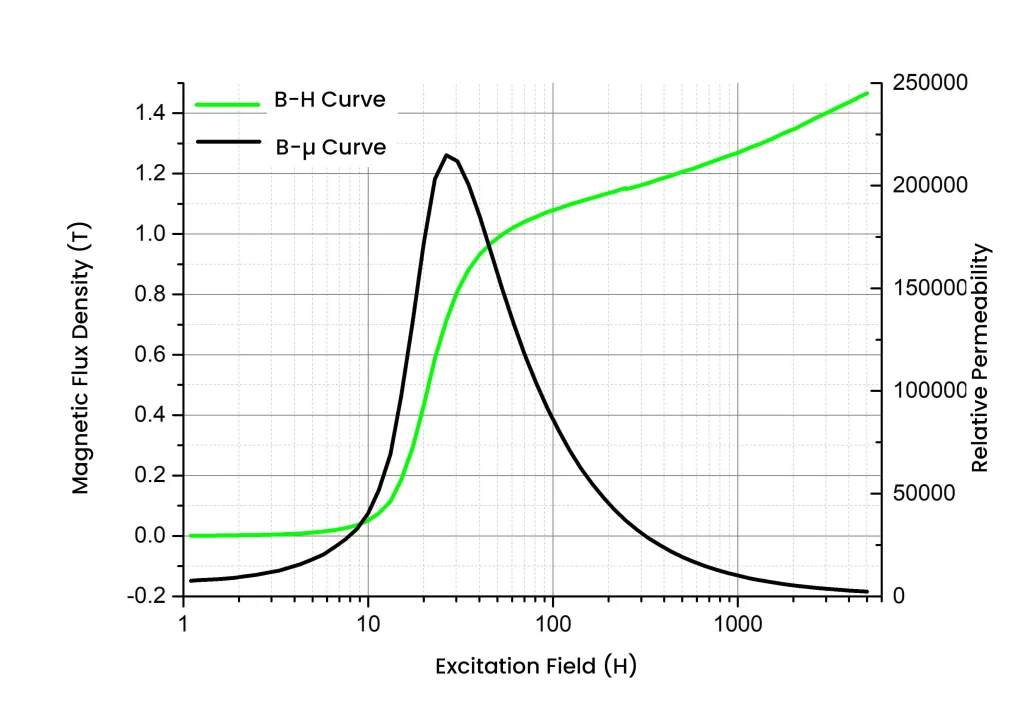
High magnetic permeability, with a relative permeability exceeding 100,000 H/m.
Low coercivity (1.2A/m).
Significantly affected by stress.
1J22(Hiperco50, Permendur, 49КФ, AFK502, SME SMEV)
It’s high saturation magnetic induction strength iron-cobalt-vanadium soft magnetic alloy; the alloy has the highest saturation magnetic induction intensity (2.4T), high Curie point (940 °C), and maximum saturation magnetostriction coefficient (60~100×10-6).
Due to its large magnetostriction coefficient, it is very suitable for magnetostrictive transducers, with high output energy and high working efficiency. The alloy has a low electrical resistivity (0.27 μΩ·m) and should not be used at high frequencies.
It is suitable to be used as light weight and small volume electrical components for aviation and aerospace, such as microelectronic rotors, electromagnet pole heads, relays, transducers, etc.
Properties
Key properties of soft magnetic 1J22 material.
Thinckness[mm]
0.1
0.2
0.35
Lateral thickness tolerance[μm]
±4
±6
±7
Layer insulation resistance[Ω]
>30
>30
>30
Stacking Factor[%]
0.94
0.96
0.98
Width[mm]
225
235
255
Saturation magnetization[T]
2.4
2.4
2.4
Curie Temperature[℃]
980
980
980
Magnetostriction Coefficient[10
−6
]
65
78
97
Resistivity[μΩ·m]
0.31
0.27
0.25
Thermal Expansion Coefficient[10
−6
/K]
12
12
12
Magnetic Properties
Thinckness(mm)
Static Magnetic Performance(T) at Different Magnetic Field Intensities(A/m)
B400
B4000
B8000
Coercivity(A/m)≤
0.1
1.68-1.79
2.28-2.31
2.35-2.4
120-148
0.2
1.70-1.80
2.30-2.33
2.40-2.41
115-135
0.35
1.70-1.81
2.20-2.24
2.28-2.34
123-135
Iron Loss at Different Working Point
The diagram below illustrates the iron loss of materials with different thicknesses at various operating points.
Thickness
(mm)
f/Hz
P1.5
P2.0
P2.1
0.1
50
400
800
1000
3.54~4.74
30.15~39
62.7~82.4
74.6~105.9
6.32~9.05
48.7~63.2
103~131.5
122~173.1
8.29~11.8
55.5~69.4
114.1~153.1
138.8~197.8
0.2
50
400
800
1000
3.68~4.03
35.2~36.3
84.7~87.7
115.2~121.4
6.7~7.87
58.4~64.2
144~156.1
198~210.8
8.33~9.84
64.0~77.6
157.0~179
222~241
0.35
50
400
800
1000
3.79~4.19
45.1~51.3
125.1~145
177.5~206
6.29~9.27
77.5~88.4
227~258
332~374
7.00~9.75
85.7~99.8
241~290.5
369.5~434
Compare with Electrical Sheets
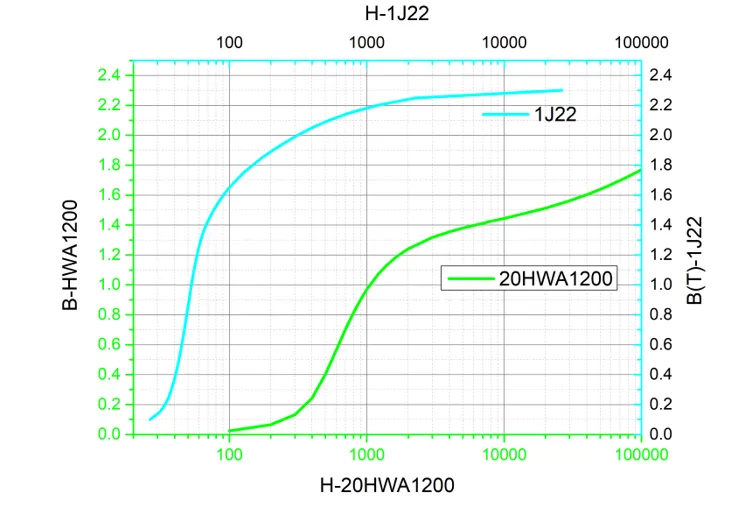
BH curve comparison between 1J22 and electrical steel
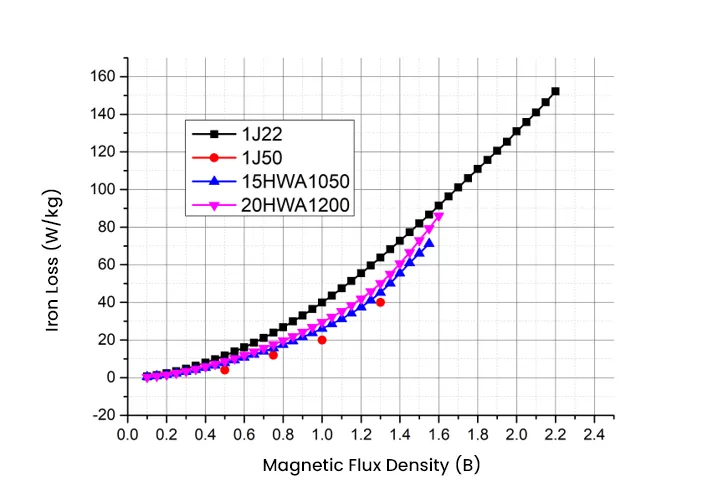
Loss curve comparison between 1j22 and electrical steel
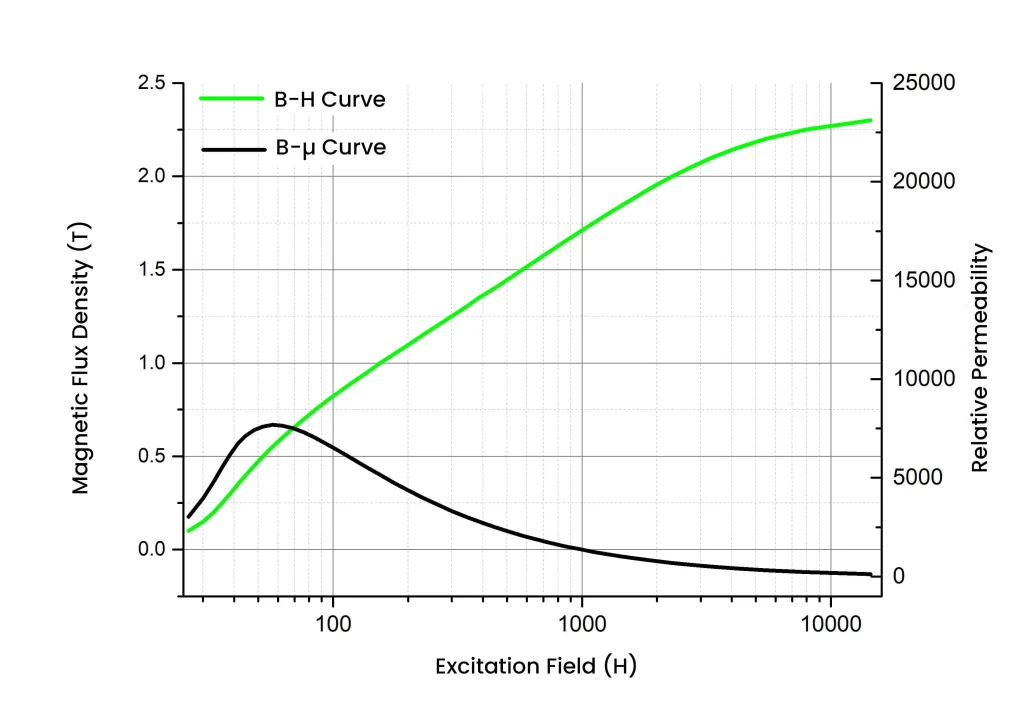
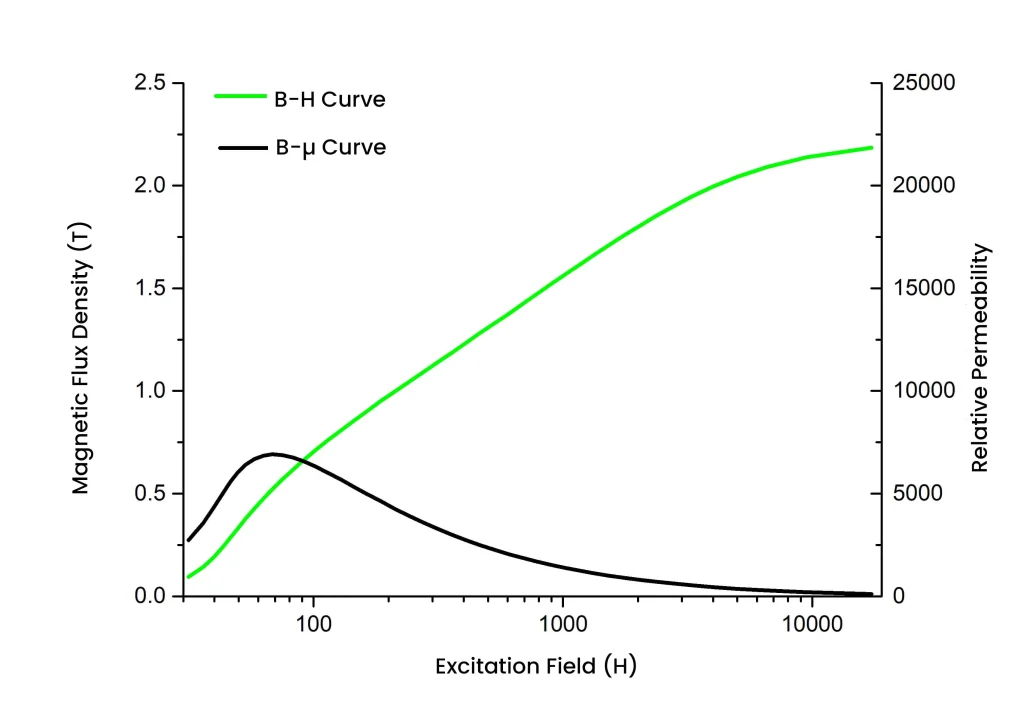
BH Curve
1J22 BH Curve
1J27 BH Curve
1J50 BH Curve
Maximize efficiency and reliability in your motors