E-Mobility
As new energy vehicle drive motors become smaller and more efficient, thinner materials are increasingly being used. Huaci’s self-bonding lamination process helps cut down on eddy current and hysteresis losses, boosting the motor’s overall efficiency.
Laminated Cores in E-Mobility
The stator core is the main structural part of electric drive units in new energy electric vehicles (EVs). It’s usually made by stacking multiple layers of silicon steel sheets. Its main roles are to support the motor windings, form part of the magnetic circuit, and transfer electromagnetic energy during operation.
Most stator cores use non-oriented electrical steel, a soft magnetic alloy made of silicon and iron. These silicon steel sheets are layered and then bonded together using special techniques to create a strong, continuous structure.
A key focus for stator cores is reducing core losses, which mainly include eddy current and hysteresis losses. When exposed to an alternating magnetic field, the core generates eddy currents that create heat and waste energy, known as eddy current loss.
Self-Bonding Motor Cores
Huaci’s self-bonding process involves applying a special adhesive coating to the surface of electrical steel, which is then treated with a specific drying process to activate the coating. During the heating and stacking process, the activated coating bonds the layers together, forming the motor core.
The adhesive fills the gaps between the laminations, creating a more compact structure. This significantly improves thermal conductivity, aiding in heat dissipation during motor operation. Additionally, the self-bonded core helps reduce eddy current and hysteresis losses, enhancing the motor’s energy efficiency.
Key Benefits
Huaci’s self-bonded iron cores enhance efficiency, reduce noise and vibration, improve structural strength, and meet automotive NVH requirements. They also lower iron losses, improve heat dissipation, and allow flexible designs, making them ideal for electric vehicle motors.
Main drive motors in EVs require high power density, efficiency, low noise, reliability, and integrated designs to meet performance demands.


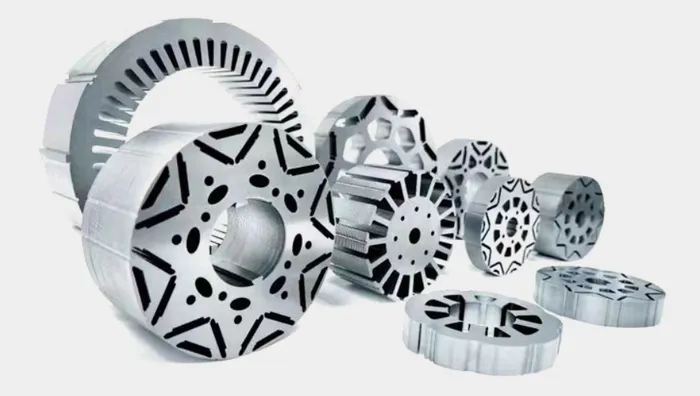
Product Gallery
Our customized cores for E-mobility motors.
FAQs
Do you support other stacking methods, such as riveting or welding?
We do not support riveting or welding for stacking. We specialize in developing and providing self-bonding rotor and stator solutions to offer our customers more efficient and precise products.
How do you ensure product quality?
We guarantee product quality through advanced testing equipment and rigorous testing processes. All stators and rotors undergo precise testing to ensure mechanical accuracy, dimensional stability, and magnetic performance, providing reliability and stability in practical applications.
How long does prototyping take?
Prototyping typically takes 15 to 30 days, depending on the specific process and product complexity. With advanced production equipment and a skilled technical team, we can respond to your needs quickly. If your project is time-sensitive, please let us know, and we will optimize the process to shorten delivery times.
What is the minimum order quantity?
We can produce as few as one piece! We support small-batch prototyping and welcome customers to evaluate their projects through samples. This allows for a quick validation of design effectiveness and performance, laying the foundation for future mass production.
What types of testing and evaluation do you offer?
We are equipped with various testing devices to perform dimensional accuracy checks, stress tests, and magnetic performance evaluations. Our comprehensive testing methods ensure every product meets strict quality standards, supporting the success of your project.
Maximize efficiency and reliability in your motors
Partner with us for advanced core manufacturing!