The dream of urban air mobility is flying closer to reality, with electric vertical takeoff and landing (eVTOL) aircraft poised to reshape our cityscapes. At the heart of this revolution lies the electric motor, a component whose performance dictates the viability of these next-generation vehicles. For eVTOLs to be successful, their propulsion systems must be exceptionally powerful, lightweight, and efficient. This has sparked a growing exploration into advanced magnetic materials and flexible manufacturing approaches, as engineers push the boundaries of what’s possible in electric motor design for next-generation aircraft.
The Propulsion Demands of eVTOL Aircraft
Unlike electric cars, eVTOL aircraft have no room for compromise. Every gram of weight is critical, and every watt of power is precious. The electric motors in an eVTOL’s powertrain face a unique set of demanding requirements:
- Extreme Power Density: Motors must deliver maximum power with minimal weight and size. This is essential for achieving vertical lift and efficient forward flight.
- Peak Efficiency: High efficiency translates directly to longer flight times and increased operational range. It also minimizes waste heat, a critical factor in compact, air-cooled engine nacelles.
- Superior Thermal Management: The high currents required for takeoff and landing generate significant heat. The motor materials must perform reliably at elevated temperatures and allow for effective heat dissipation to prevent overheating and ensure safety.
Conventional soft magnetic materials—such as silicon steel or standard electrical steels—struggle to meet the extreme demands of eVTOL propulsion systems. Their relatively low magnetic saturation (typically around 1.5–2.0 Tesla) limits the maximum magnetic flux density a motor can achieve, which directly caps the torque and power output for a given size and weight. Additionally, these materials tend to exhibit higher core losses at the high frequencies required for compact, high-speed motor operation, leading to excessive heat generation. This not only reduces efficiency but also imposes stricter demands on thermal management—already a challenge in tightly packed, air-cooled eVTOL nacelles.
Furthermore, their mechanical properties may restrict the use of ultra-thin laminations or complex geometries, limiting design flexibility. These limitations have driven engineers to pursue more advanced magnetic materials and processing methods to unlock the next level of power density, efficiency, and reliability in eVTOL motor design.
Advanced Magnetic Materials: A Path to Higher Power Density
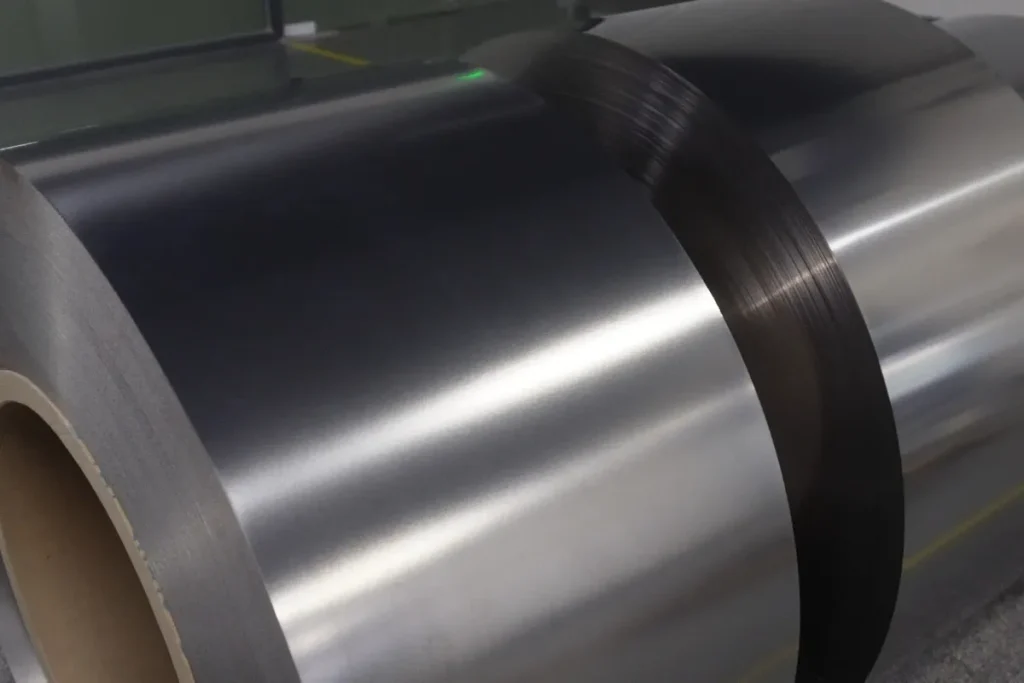
To overcome the limitations of conventional magnetic materials, eVTOL motor developers are increasingly turning to higher-performance alternatives. One promising class of materials that meets these criteria is cobalt-iron (CoFe) alloys. Known for their exceptionally high saturation flux density—CoFe alloys enable the generation of stronger magnetic fields within compact motor geometries. This is particularly valuable for eVTOL designs, where maximizing torque and thrust from minimal volume and weight is essential. In addition, CoFe alloys offer better magnetic permeability and reduced energy loss at high switching frequencies, making them well-suited for high-speed, high-efficiency propulsion systems.
- Ultra-High Magnetic Saturation: Cobalt-iron (CoFe) soft magnetic alloys offer among the highest magnetic saturation levels of any commercially available material, with certain grades reaching up to 2.4 Tesla. This allows electric motor designers to achieve stronger magnetic flux in a compact core structure. A higher flux density translates directly into greater torque and power output for the same motor size, significantly improving power density and enabling lighter, more compact propulsion systems.
- High Permeability: These alloys also exhibit high magnetic permeability, meaning they can be magnetized effectively with a relatively low applied magnetic field. This reduces the energy required to establish magnetic flux in the motor core, contributing to improved overall system efficiency—especially important for high-frequency, high-speed motor applications.
- Low Core Losses: Despite their high saturation, CoFe alloys can maintain relatively low core losses even at elevated frequencies. In high-speed electric motors, core losses manifest as waste heat, which can reduce efficiency and create thermal management challenges. By minimizing these losses, CoFe materials help improve thermal stability, reduce cooling requirements, and support the reliable performance of propulsion systems operating under demanding eVTOL flight conditions.
For reference, one widely used cobalt-iron alloy—commonly referred to as VACOFLUX 50—achieves a magnetic saturation of approximately 2.35–2.4 Tesla, significantly higher than that of conventional silicon steel. Its relative permeability can exceed 4,000 (at low field strength), and it maintains low core losses even at frequencies above 1 kHz, depending on lamination thickness and processing. These characteristics make it a benchmark material for evaluating high-performance motor core behavior under demanding electromagnetic conditions.
Innovations in Motor Core Manufacturing
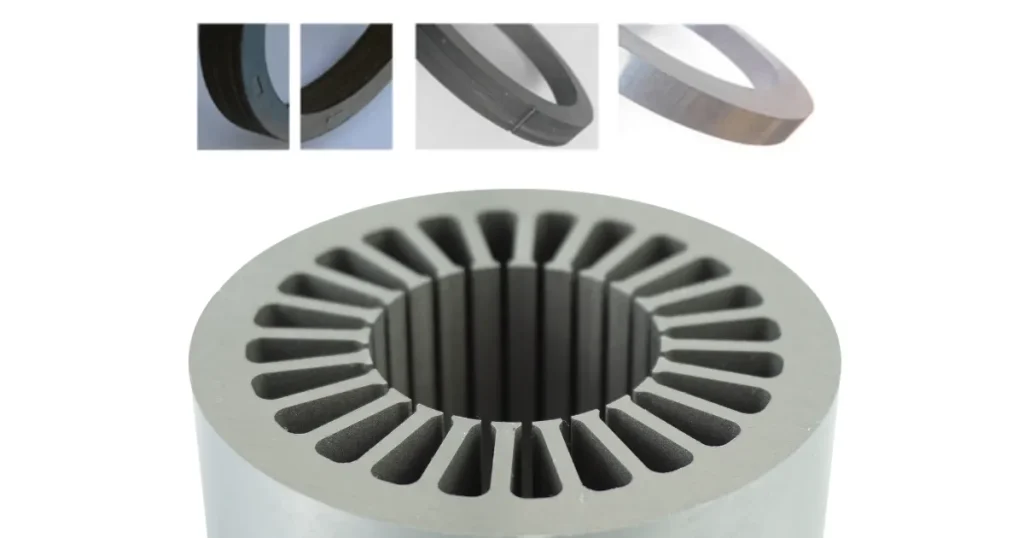
Transforming high-performance magnetic materials into functional motor cores requires more than just raw material properties—it demands precision manufacturing and deep process understanding. From ultra-thin lamination stamping to stacking, each step directly affects the magnetic performance, mechanical integrity, and thermal stability of the final core. One of the key challenges lies in minimizing performance loss during forming and assembly, especially for high-saturation materials like cobalt-iron alloys, which can be sensitive to mechanical stress and heat treatment conditions.
To address this, Huaci Technologies has developed and refined a range of advanced processing techniques, supported by continuous testing and an internal performance database built from years of prototyping. These capabilities not only ensure consistent quality and performance but also enable us to support rapid design iteration—helping motor developers shorten development cycles and validate their concepts faster. One of the most impactful solutions we’ve implemented is the self-bonding lamination process.
Seamless Integration with Self-Bonding Solutions
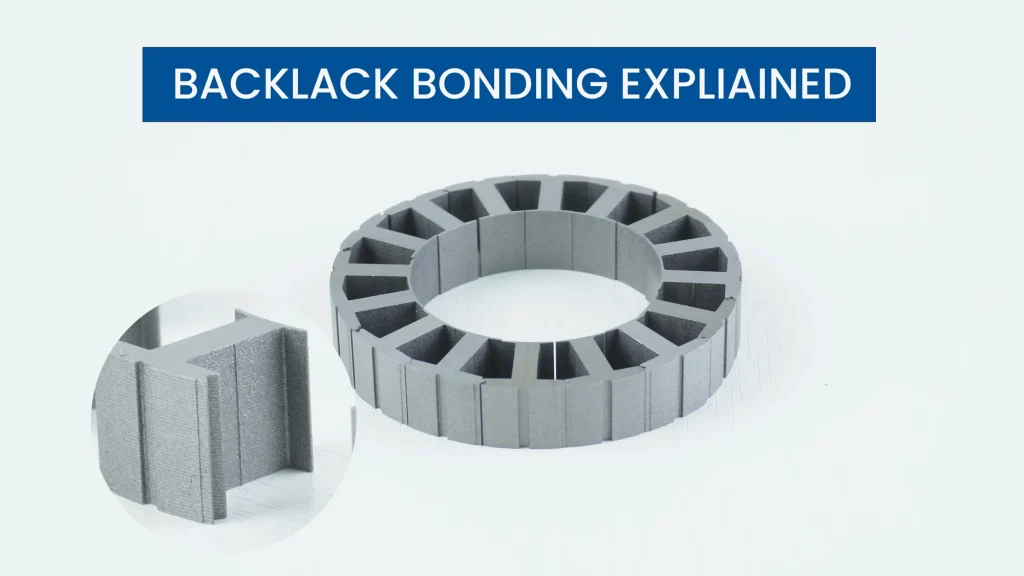
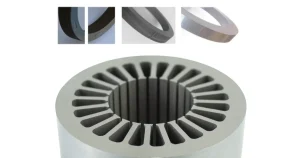
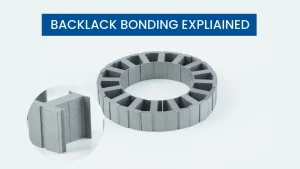
Traditional motor core manufacturing involves stamping and stacking laminated sheets, often joined by welding or interlocking. In contrast, the self-bonding process applies a self-bonding adhesive coating to each lamination, which bonds during a controlled three-stage curing cycle. This eliminates mechanical fasteners, improves structural integrity, and ensures better magnetic continuity, making it ideal for high-performance motor cores. This approach offers several advantages:
- Improved Mechanical Integrity: The bonded stack forms a solid, robust core, improving its durability and resistance to vibration.
- Enhanced Magnetic Performance: By eliminating the need for mechanical fasteners like welds, which can disrupt the magnetic flux path and create loss points, the self-bonding technique ensures better magnetic performance and lower overall core losses.
- Design Freedom: The technology allows for the creation of more complex and intricate core geometries, enabling designers to optimize the magnetic flux path for higher efficiency and performance.
Small-Batch Rapid Prototyping: From Design to Reality, Faster
Developing a high-performance motor is inherently iterative. Engineers must rapidly explore and validate different core designs, materials, and assembly methods to meet strict targets for power, efficiency, and thermal performance. However, access to small-batch, application-ready cores—especially using advanced soft magnetic materials—is often limited by long lead times and rigid processing constraints.
To support this need, Huaci Technologies offers a flexible rapid prototyping service tailored to electromagnetic applications. Our self-bonding process accommodates a wide range of geometries and stacking configurations, enabling fast turnaround without compromising performance. Combined with years of technical accumulation in handling ultra-thin soft magnetic alloys and complex core structures, we help motor developers accelerate design validation, reduce risk, and move confidently from concept to implementation. This provides motor developers with unparalleled agility:
- Speed: Accelerate development with fast delivery of prototype cores—thanks to in-house processing of soft magnetic materials using self-bonding laminations and precision laser cutting.
- Flexibility: Test various design iterations without committing to large-volume production tooling, saving significant cost and time. Our fine-tolerance processing and adaptable bonding techniques support complex geometries and ultra-thin laminations.
- Agility: Project-based service ensures close technical coordination and rapid response at every stage—from drawing to final inspection—helping engineers validate performance early and iterate quickly.
This capability provides critical support to engineering teams in the fast-moving eVTOL sector, enabling them to iterate quickly, explore ambitious designs, and accelerate the path from concept to a next-generation propulsion system—an advantage that’s especially vital in such a highly competitive and innovation-driven field.
A Winning Combination for the Future of Flight
The journey toward making urban air mobility a practical reality demands continuous innovation at every level. At the heart of high-performance eVTOL motors lies one decisive factor: soft magnetic materials. Their magnetic saturation, losses, and processing behavior fundamentally shape motor efficiency, power density, and thermal performance. Huaci Technologies bridges the gap between cutting-edge soft magnetic materials and manufacturable motor cores through precision self-bonding techniques and rapid prototyping capabilities. As eVTOL designs evolve toward greater complexity and tighter tolerances, we remain committed to advancing materials engineering and process innovation—helping our partners turn bold concepts into flyable reality, one breakthrough at a time.