Why Bonding is Revolutionizing Motor Manufacturing
In the race for higher motor efficiency, greater power density, and lower noise—especially in critical applications like electric vehicles (EVs), aerospace, and high-performance industrial automation—traditional stator manufacturing methods like riveting or welding are hitting their physical limits. Enter the “bonded lamination stator,” an advanced technology that is rapidly becoming the gold standard for high-performance motors.
Unlike conventional methods, the bonding process transforms the stator core into a single, mechanically rigid, and magnetically superior component. But how is this actually achieved?
This article provides a deep dive into the precision manufacturing process of a bonded lamination stator. We will break down every step, from raw material to finished product, demonstrating how this process fundamentally solves core challenges in eddy current loss, mechanical vibration, and thermal management.
What is a Bonded Lamination Stator?
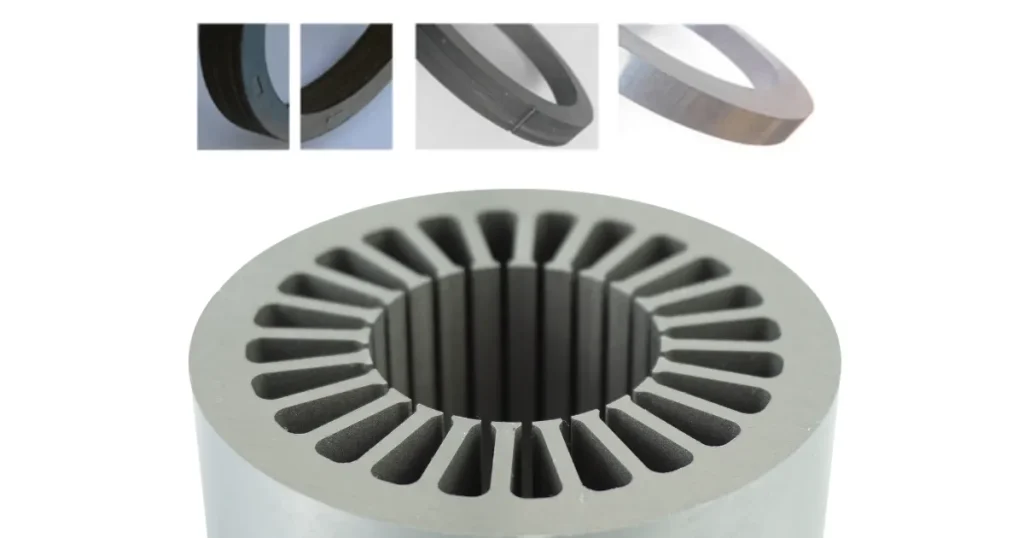
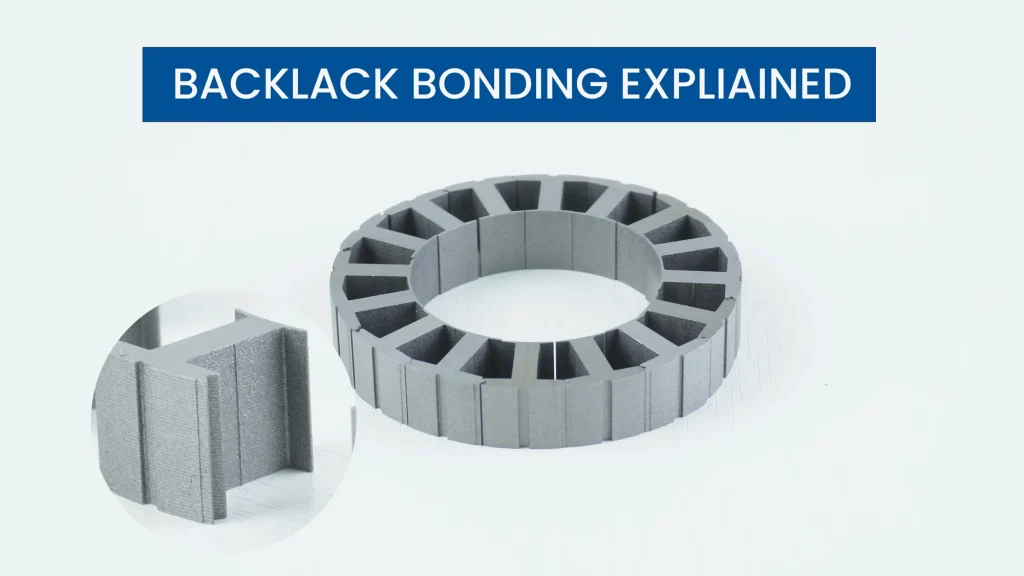
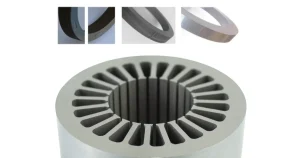
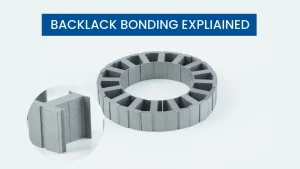
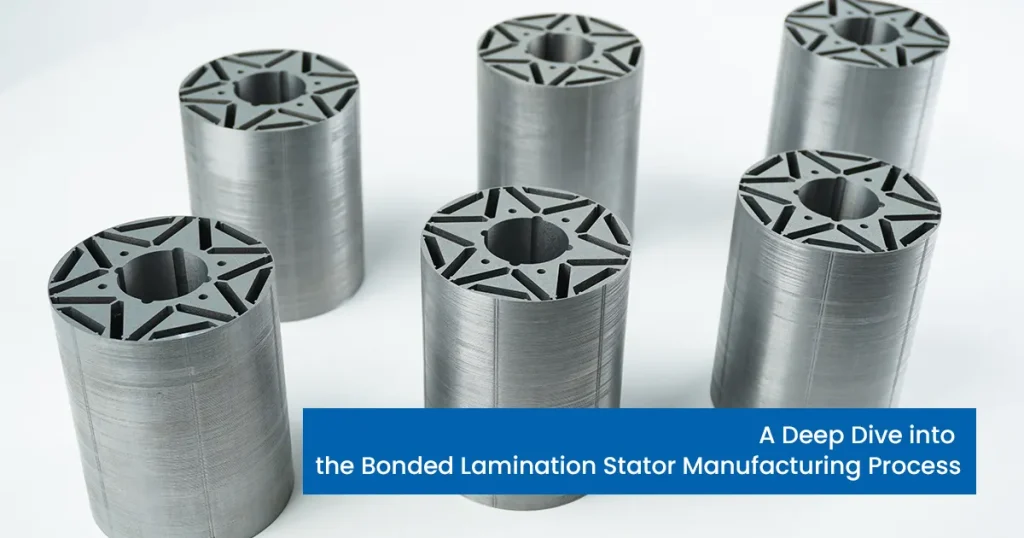
In short, a bonded lamination stator is a motor core built from many layers of ultra-thin electrical steel (laminations). Instead of relying on welds or rivets to hold these layers together, they are fused by a specialized adhesive coating (often called Backlack or self-bonding varnish) under high heat and pressure.
The problem with traditional methods is clear:
- Welding: Creates localized high heat, which damages the magnetic properties of the steel at the seam. It also creates a “short circuit” path between laminations, dramatically increasing eddy current losses.
- Riveting: Also creates electrical shorts between layers and introduces mechanical stress points into the core, compromising the uniformity of the magnetic flux path.
The bonding process elegantly solves these problems by maintaining a uniform, complete layer of insulation between every single lamination. The result is a core with fully bonded interfaces — eliminating air gaps and loose layers, preserving the magnetic path continuity, and ensuring maximum utilization of the material’s intrinsic magnetic and mechanical properties.

The 5 Key Stages of Bonded Lamination Stator Manufacturing
Producing a high-quality bonded lamination stator is a precision, multi-stage process that demands a deep understanding of materials, tolerances, and thermodynamics.
Stage 1: Material Selection and Preparation
This is the foundation for a high-performance core.

- Silicon Steel: The choice is critical. For high-frequency applications, thinner laminations (e.g., 0.2mm or even 0.1mm) are selected to minimize eddy current effects. The grade of the steel dictates its magnetic permeability and core loss characteristics.
- Soft Magnetic Alloy (Fe-Co Alloy): When extremely high magnetic saturation and power density are required—such as in aerospace, racing, or high-speed motor applications—Fe-Co alloys are often used. They offer significantly higher magnetic flux density than silicon steel, while maintaining excellent mechanical strength. However, their higher cost and more demanding processing (including bonding and cutting) require precise manufacturing control to fully exploit their potential.
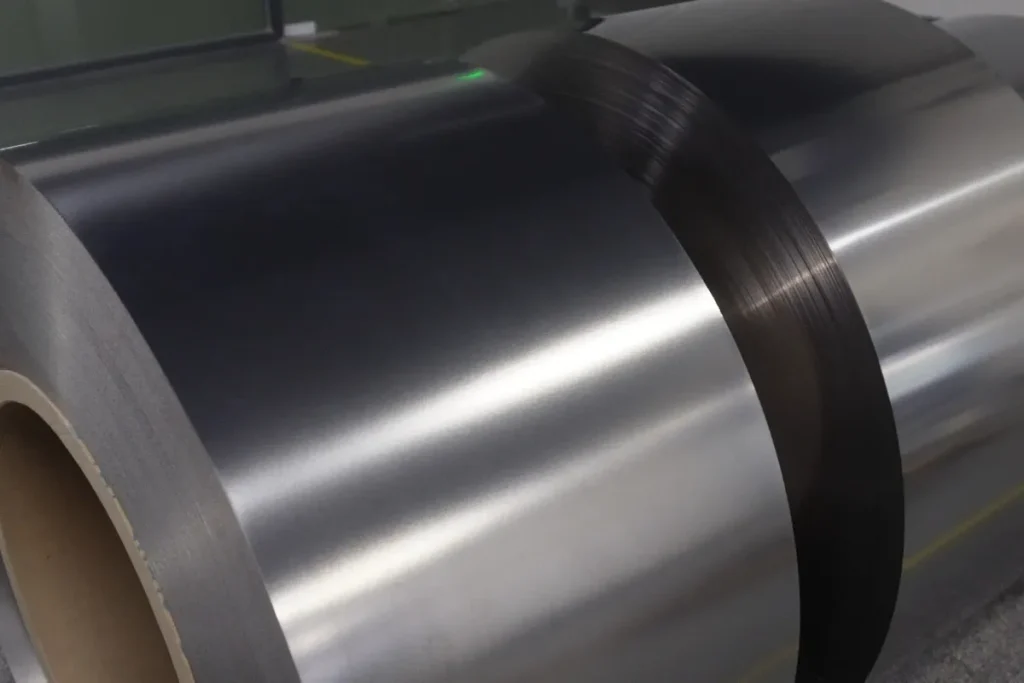
- Adhesive: The most common choice is Backlack, an epoxy-based self-bonding coating that is pre-applied to the electrical steel coil. This coating is inert at room temperature (or slightly tacky, to aid in positioning) but activates and cures at a specific temperature. The adhesive must be selected based on the motor’s maximum operating temperature, required shear strength, and compatibility with cooling agents (like oil in oil-cooled motors).
Stage 2: Precision Stamping
This is the step that defines the stator’s geometry and electrical performance.
- The Process: A high-speed precision press is used to stamp the individual stator lamination sheets from the Backlack-coated steel coil.
This step is critical, as the quality of the stamp is a make-or-break factor. Burrs created during stamping must be strictly controlled. An excessive burr can puncture the insulating coating of the adjacent lamination, creating a short circuit and negating the entire benefit of the bonding process. This requires exceptionally well-maintained, high-precision tooling.
Stage 3: Stacking and Alignment
In this phase, the individual laminations are assembled into the prototype stator core.
- The Process: Stamped laminations are accurately fed into a dedicated stacking fixture or an automated stacking station.
- The Key: Every layer must be perfectly aligned. Modern manufacturing often uses automated systems with internal guide pins or external features (like small notches on the laminations) to achieve high-precision alignment. The accuracy of this step directly impacts the final “stacking factor”—the percentage of the core’s volume that is actual steel.
Stage 4: Curing — The Heart of the Bonding Process
This is where the “bonding” truly happens and where the most technical expertise lies.
- The Process: The aligned stack of laminations, often still in its fixture, is placed under precise pressure and then heated in an industrial oven or via an induction heating system.
- Thermodynamic Control: This process must follow the technical specifications of the Backlack coating exactly.
- Heating: As the temperature rises, the Backlack coating softens and begins to flow, filling microscopic gaps between the laminations.
- Pressure: Continuous pressure ensures intimate contact between layers and a uniform, thin bond line.
- Curing: After reaching a specific peak temperature (typically between 150°C – 250°C) and being held for a set duration, the adhesive cross-links, transforming from a liquid/soft state into a hard, thermoset solid.
The precise control of the pressure, temperature curve, and curing time is the core manufacturing know-how of this process. Heating too quickly or slowly, or applying insufficient or excessive pressure, can lead to incomplete bonding, high internal stresses, or adhesive carbonization.
Stage 5: Post-Processing and Quality Assurance
After cooling, the core is removed from the fixture as a single, solid component.
- Finishing: Depending on the design, some finishing may be required, such as turning or grinding the outer diameter (OD) or inner diameter (ID) to meet final precision tolerances.
- Quality Control (QC): This is essential for building trustworthiness. Testing typically includes:
- Dimensional Measurement: Using a CMM (Coordinate Measuring Machine) to check for height, concentricity, and flatness.
- Electrical Testing: Measuring the interlaminar resistance to verify insulation integrity and ensure no short circuits.
- Mechanical Testing: (On a sample basis) Performing push or shear tests to validate the bond strength.
Why This Manufacturing Process is Superior
The manufacturing process for a bonded lamination stator directly translates to performance benefits that traditional methods cannot match:
- Minimized Iron Loss: The uniform insulation layer virtually eliminates interlaminar eddy currents, which is especially significant for energy savings at high frequencies (as seen in high-speed motors).
- Superior Mechanical Integrity: The cured core acts as a solid, monolithic block. This allows it to withstand extreme rotational speeds and vibrations, significantly reducing the motor’s NVH (Noise, Vibration, and Harshness).
- Improved Thermal Management: The adhesive layer fills air gaps, providing a better thermal conduction path than air. This helps dissipate heat from the stator windings to the motor housing or cooling system more effectively.
- Design Freedom: With no need to account for weld spots or rivet holes, engineers can design more complex magnetic circuits or make laminations even thinner, further optimizing motor performance.
Conclusion: A Solid Foundation for Next-Generation Motors
The manufacturing process of a bonded lamination stator is a sophisticated technology that blends materials science, precision engineering, and thermodynamic control. While it places higher demands on equipment and process control, the performance payoff is immense.
A bonded core is not merely a stack of thin steel sheets — it is the balance point where energy flows efficiently and structure remains stable. Every material choice, every micrometer of lamination thickness, and every curing curve reflects a compromise between magnetic performance, mechanical integrity, and manufacturability.
The thinner the material, the smaller the eddy currents and the higher the efficiency — yet every reduction in thickness multiplies the challenge in strength, insulation, and dimensional control. Each parameter, from tooth geometry to bonding layer thickness, directly shapes flux density, temperature rise, and vibration behavior.
In essence, manufacturing a bonded lamination stator is not just a production process, but a deep optimization of magnetics, heat, and stress. To master it requires not only precise equipment, but also a deep understanding of how materials, processes, and structure interact.
And this is where we focus — leveraging advanced bonding technology, refined materials, and years of manufacturing experience to create motor cores that are more efficient, compact, and reliable.
Huaci Technologies, with our deep experience and expertise in bonded lamination stator manufacturing, is committed to delivering motor core solutions that meet the highest standards of performance and quality.
If you are seeking superior core performance for your next motor project, contact our engineering team today to discuss how our bonded lamination technology can be customized for your needs.