Introduction
This post breaks down the key specs of brushless DC motors. It’s a quick guide to help you pick the right motor for your project. We’ll cover: Motor size (like what “2212” means for stator dimensions), KV value (how fast the motor spins per volt), No-load current and voltage, Maximum current and power limits, How resistance impacts efficiency, The concept of thrust-to-power ratio (total force efficiency). By the end, you’ll know what matters most when choosing a motor to maximize performance and efficiency.
Drone Motor Size
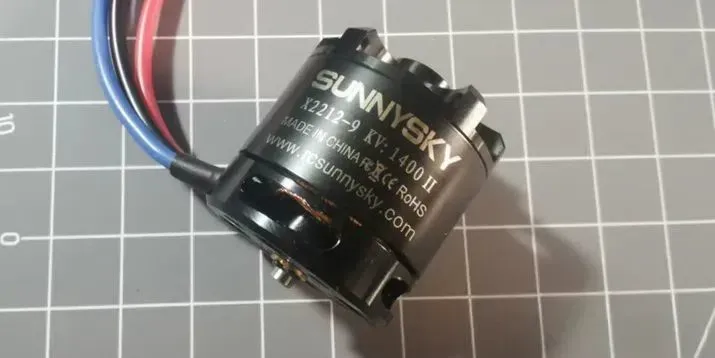
Motor size depends on the stator dimensions, shown as 4 digits in the motor name.
Example: A “2212” motor means a stator diameter of 22mm and height of 12mm.
The first two digits represent diameter; the last two represent height.
Larger numbers = bigger motors. A taller, wider motor provides more power, making it ideal for larger drones.

KV Value
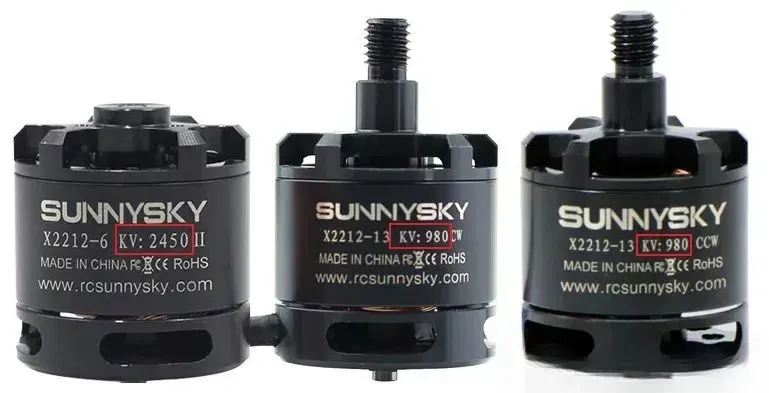
KV tells you how fast the motor spins with no load when 1 volt is applied.
Units: KV is measured in RPM/V (rotations per minute per volt).
Example: A 1000KV motor spins 1,000 RPM with 1V applied. Lower KV motors have more windings, handle more power, and create higher torque. Higher KV motors spin faster but generate less torque, making them better for small props.
No-Load Current and Voltage
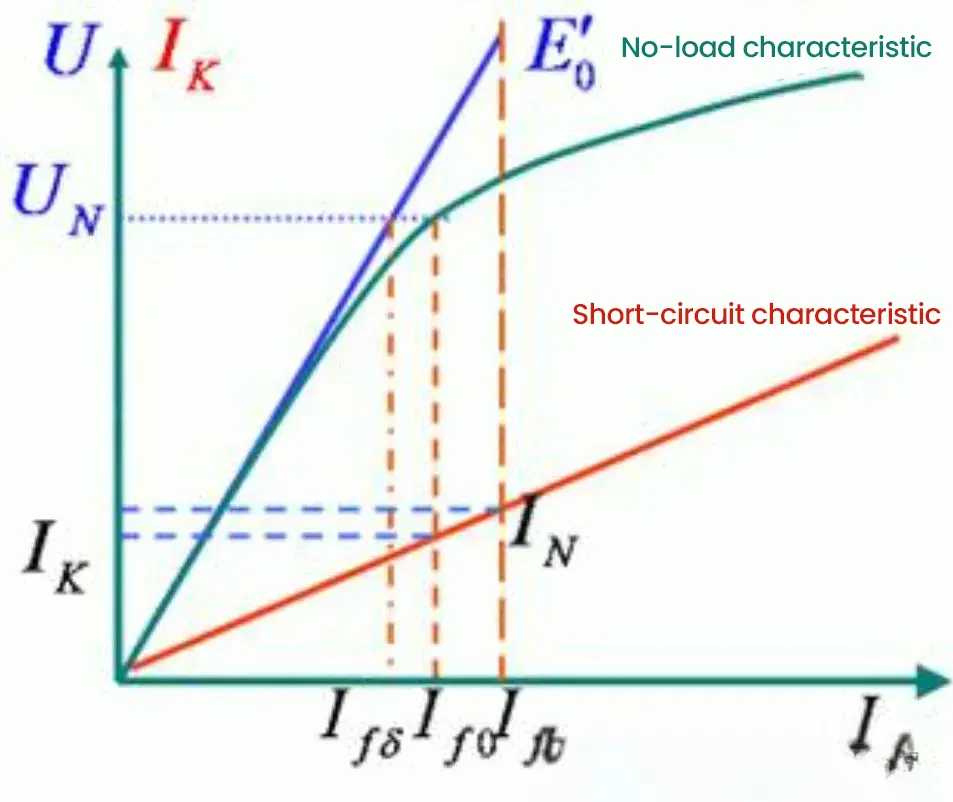
No-load current is the current the motor uses when it spins without a prop at a set voltage (e.g., 10V or 24V).
Why it matters:
Estimate resistance: Measure no-load current to calculate winding resistance. This helps you gauge energy loss.
Check quality: Lower, stable no-load current signals good motor quality. A high value could mean defects.
Optimize efficiency: Less no-load current means fewer energy losses, boosting potential efficiency.
Match components: Helps pair the motor with the right ESC (electronic speed controller).
Max Current and Power
These values define the motor’s safe limits during operation.
Example: “25A/30s” means the motor handles 25A for 30 seconds before overheating.
Exceeding max current or power risks permanent damage.
Drone Motor Efficiency
Efficiency measures how well the motor converts electrical power into mechanical power.
Formula:
Electrical Power (W) = Voltage (V) × Current (A)
Efficiency = Mechanical Power (W) ÷ Electrical Power (W)
Efficiency isn’t constant. It changes with voltage (throttle) and load (propeller).
For the same propeller, motor efficiency can drop as input voltage (and current) rises. Higher voltage increases current, which generates more heat and energy losses. This reduces the share of input power converted into useful mechanical output.

This chart is a motor performance curve, showing speed, current, power, and efficiency at different torque levels:
- Torque (horizontal axis in mNm).
- Speed (blue curve, left vertical axis in RPM).
- Current (black curve, right vertical axis in amps).
- Power (green curve, right vertical axis in watts).
- Efficiency (red curve, right vertical axis in %).
It shows:
- Speed drops as torque increases.
- Current rises with torque.
- Power peaks, then drops with increasing torque.
- Efficiency hits a high point, then declines as torque grows.
Thrust Efficiency
A power system’s performance depends on how well the motor and propeller pair. We call their combined effectiveness “thrust efficiency.” It’s defined as:
Thrust Efficiency (g/W) = Propeller Thrust (g) / Input Power (W) = Propeller Efficiency × Motor Efficiency.
Neither motor nor propeller efficiency stays constant. So, thrust efficiency shifts with operating conditions. Manufacturers often provide thrust efficiency charts for specific motors. These charts help designers pick the best motor-propeller combination for their needs.
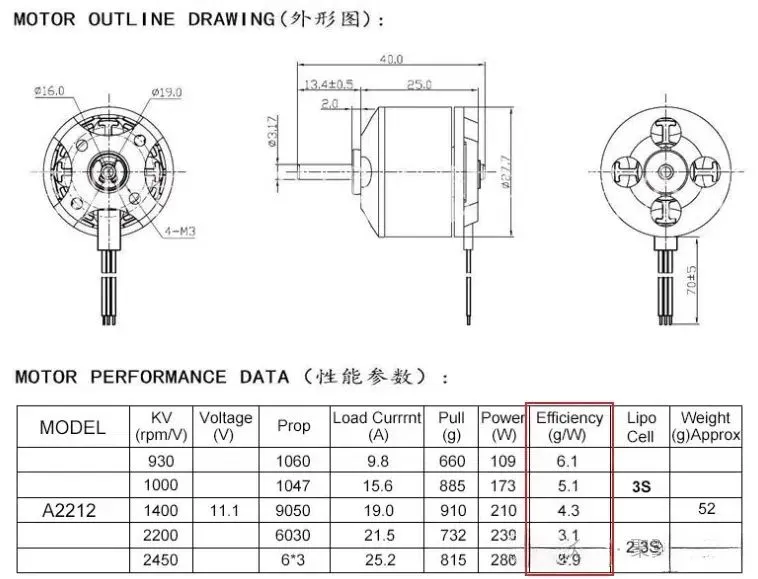
Thrust efficiency, measured in grams per watt (g/W), shows how much thrust the system generates per watt of input power.
Why thrust efficiency matters:
- Optimize power systems: Compare different motor-propeller combos. Find the most efficient setup for max flight time or performance.
- Evaluate energy use: Higher thrust efficiency means more thrust with less energy. This reduces battery drain and boosts flight endurance.
- Guide design choices: For drones or multicopters, designers use thrust efficiency to select motors and props. It ensures the system has enough lift and agility.
- Lower costs: High thrust efficiency lowers energy demands. This cuts operating costs without sacrificing performance.
- Predict performance: Use efficiency data to forecast drone behavior under various loads. Adjust systems to match tasks or conditions.
Conclusion
Understanding these motor specs is key to building efficient, high-performance drones. Whether you want speed, power, or efficiency, these parameters guide your choices. Use TFE and other data to match motors and props for optimal results.